
Sign Up
Login
Try for Free
Login

Updated August 2026
If you work in therapy, counseling, or behavioral health, you have probably had to explain to a new clinician or intern what a DAP note is, and how it differs from the SOAP format they may have learned first. DAP is one of the standard progress note structures in outpatient mental health, and the distinction trips up a lot of clinicians early on.
This guide covers what a DAP note is, what belongs in each section, how it compares to SOAP and the other behavioral health formats, and what payers and auditors check when they read one.
A DAP note is a three-part clinical progress note that organizes a therapy session into Data, Assessment, and Plan. It merges the Subjective and Objective sections of a SOAP note into a single Data section, then keeps Assessment and Plan. DAP is a documentation convention rather than a regulated form: we found no law or payer manual that requires the headings by name.

DAP stands for Data, Assessment, Plan.
The format is a behavioral health adaptation of the SOAP note, which came out of Lawrence Weed's problem-oriented medical record in the 1960s. SOAP was built for medical and multidisciplinary care, where the split between what a patient reports and what a clinician measures carries real diagnostic weight.
Psychotherapy sessions rarely divide that cleanly. What a client says is much of the clinical data, so DAP lets the session's material sit in one place. No standards body or founding publication established DAP as a formally standardized note type, and we found no law or payer manual that requires the Data, Assessment, Plan headings by name.
Everything the session produced: what the client reported, what you observed, mental status highlights, any scores or logs, the interventions you delivered, and the therapy time when a time-based code is billed.
Include at least one observable or measurable anchor. A PHQ-9 or GAD-7 score, a symptom count, a homework completion rate, or a SUDS trajectory gives the next reviewer something to verify. Name the interventions you actually delivered, specifically enough that a reader can tell what the service was.
Your clinical interpretation of what the Data means: progress toward a numbered treatment plan goal, diagnostic impression and course, changes in functioning, and current risk status.
This section carries the medical necessity link. Interpretation is the job here, not repetition. If the Assessment restates the Data in different words, the note has no clinical reasoning in it, and reviewers read that absence as a service that was not justified.
What happens next: interventions for coming sessions, homework or between-session tasks, referrals and care coordination, any treatment plan changes, and the next appointment.
Write it so the next note can evaluate it. "Continue treatment" gives your future self nothing to measure against.
DAP is the default in much of outpatient behavioral health. The regulatory layer around the note changes by setting, and that matters more than the format choice.
Who typical setting regulatory layer to know therapists and counselors (LPC, LCSW, LMFT) Outpatient private practice, group practice HIPAA, state licensing board record standards, payer contracts Psychologists Outpatient therapy, assessment practice HIPAA, state board rules, payer contracts substance use and addiction counselors SUD treatment programs 42 CFR Part 2 sits on top of HIPAA. Part 2 records generally require written patient consent for disclosure, beyond HIPAA's treatment, payment and operations exception. SAMHSA's revised rule reached full enforcement on February 16, 2026 School counselors and school psychologists K-12 schools FERPA, not HIPAA, for school-employed staff. HIPAA excludes FERPA education records from the definition of PHI, and most K-12 schools are not covered entities Case managers and community mental health teams. Community behavioral health, PHP, IOP HIPAA plus state Medicaid documentation standards. Many programs favor BIRP or GIRP here because of utilization review
If you work across settings, the format can stay the same. The consent, access, and retention rules change underneath it.
This sample is fictional and for educational purposes. It does not describe a real client. Adapt any template to your organization's policies and your board, payer, and jurisdiction requirements.
Client: M.T., 34 · Date: 08/06/2026 · Session: 3 of 12
Service: Individual psychotherapy, 47 minutes, in person, office (POS 11) · Start/stop: 14:02 to 14:49
Diagnosis: Major depressive disorder, recurrent, moderate (F33.1)
D (Data): Client reported completing 5 of 7 planned behavioral activation tasks this week, up from 2 of 7 at session 2. Described returning to a weekly running group after four months away. PHQ-9 administered in session: 14, down from 18 at intake. Presented on time, alert and oriented; mood described as "flat but better," affect constricted and congruent with reported mood; no psychomotor slowing observed. Reviewed the activity log together and identified low-energy mornings as the main barrier. Delivered behavioral activation scheduling for the coming week and cognitive restructuring of the belief "if I cancel once, I have failed," with evidence review. Client denied suicidal ideation, intent, plan, and self-harm urges.
A (Assessment): Depressive symptoms improving. The 4-point PHQ-9 reduction and the increase in completed activation tasks indicate meaningful progress toward Goal 1 of the treatment plan (increase weekly activity engagement to 5 or more scheduled tasks). Client is applying skills between sessions and tolerating cognitive challenge without withdrawal. Symptoms remain consistent with major depressive disorder, recurrent, moderate, improving. Risk: denies ideation, no risk indicators observed, continue routine monitoring at each session.
P (Plan): Continue weekly individual CBT with behavioral activation. Homework: schedule 6 activation tasks with two placed before 11:00 a.m. to address the morning barrier; continue the activity log. Introduce relapse prevention planning at session 5. Re-administer PHQ-9 at session 6. Next appointment 08/13/2026.
Clinician signature: [name, credentials] · Date signed: 08/06/2026
| Weak | Strong |
|---|---|
| "Client continues to show insight and is applying coping strategies." | "The 4-point PHQ-9 reduction and increase in completed activation tasks indicate progress toward Goal 1 (increase weekly activity engagement to 5 or more scheduled tasks)." |
| "Presentation consistent with mild anxiety." | "GAD-7 of 8 at intake, 6 today, consistent with mild symptom severity by GAD-7 banding." |
| "Client is doing better." | "Panic episodes down from four to two this week, both managed without leaving the situation." |
Every strong version names the measure, the change, and the goal it maps to.
Want the full version? The DAP Note Template includes a blank copy-and-adapt template, a free PDF with a section-by-section pitfall cheat sheet and pre-sign checklist, an editable DOCX, and a second annotated sample.
A DAP note is not compliant because it is a DAP note. Audit findings turn on content, not on the choice of DAP over SOAP.
What the format does well:
What the format does not do:
DAP does not isolate the client's response to a specific intervention. BIRP, DARP, and GIRP do. If your payer mix leans hard on response to treatment, use one of those instead.
What auditors actually find. In OIG report A-09-21-03021 (May 2023), Medicare improperly paid an estimated $580 million of roughly $1 billion in psychotherapy services during the first year of the COVID-19 public health emergency, $348 million of it telehealth. Of 216 sampled enrollee days, 128 failed Medicare requirements and another 54 failed Medicare guidance. The most common failure was psychotherapy time not documented (60 of the 216 sampled days), followed by incomplete or missing treatment plans (43). Missing provider signatures (31 days) were flagged under Medicare guidance rather than requirements. None of those findings are about headings.
| Mistake | Why it gets flagged | Fix |
|---|---|---|
| Therapy time missing | The most common documentation failure in the OIG psychotherapy audit. Time-based codes (90832: 16 to 37 min, 90834: 38 to 52 min, 90837: 53+ min) cannot be verified without it | Record start and stop times. The OIG audit accepted start/stop times or total time, an older contractor fact sheet requires exact times, and MAC billing articles vary by jurisdiction, so start/stop remains the most defensible choice |
| Data with no measurable anchor | Pure narrative gives a reviewer nothing to verify | Include at least one score, count, or log per note |
| Assessment restates the Data | Breaks the medical necessity chain | Interpret: what the data means, progress toward a numbered goal, risk status |
| Clinical opinion in the Data section | Blurs observation and judgment, which weakens both | Keep inference in Assessment. Observation and client report stay in Data |
| Vague plans | "Continue treatment" leaves the next note nothing to evaluate | Name the intervention, the homework, the review point, and the next appointment date |
| Severity asserted without a measure | A severity claim with no instrument behind it is unsupported, and not every diagnosis carries DSM-5-TR severity specifiers | Cite the instrument and score, or describe function instead |
| Risk documentation skipped | Silence reads as an assessment that did not happen | Document the screen even when risk is low |
| Copy-forward text | Near-identical entries across dates of service read as a record that does not support a distinct billed service. The same cloned-note scrutiny applies to AI drafts, and CMS signature guidance (MLN905364, updated July 2025) requires the billing clinician to sign and authenticate entries produced with an AI scribe | Write each note to the session in front of you, and edit any draft substantively |
| Unsigned or late notes | Missing signatures were a named finding in the OIG audit | Sign and date every note. Most payers and state Medicaid programs expect completion within 24 to 72 hours, so check your own requirements |
Documentation is a real load in behavioral health. A 2014 national analysis found psychiatrists spent a larger share of the week on administration than any other physician specialty (20.3% of working hours, about 10.6 hours a week), and outpatient therapists commonly report adding 15 to 25 minutes of charting to each session.
What the evidence shows. The largest study to date, published in JAMA in April 2026, compared 1,809 clinicians who adopted ambient AI scribes with 6,772 who did not across five academic medical centers. Adopters spent 16 fewer minutes on documentation per eight hours of scheduled patient time, a 10% relative reduction, and 13 fewer minutes in the EHR overall, with no significant change to after-hours EHR time. Time savings are real and modest. The bigger reported effect in that literature is on clinician well-being and presence in session, which tracks with what our users tell us.
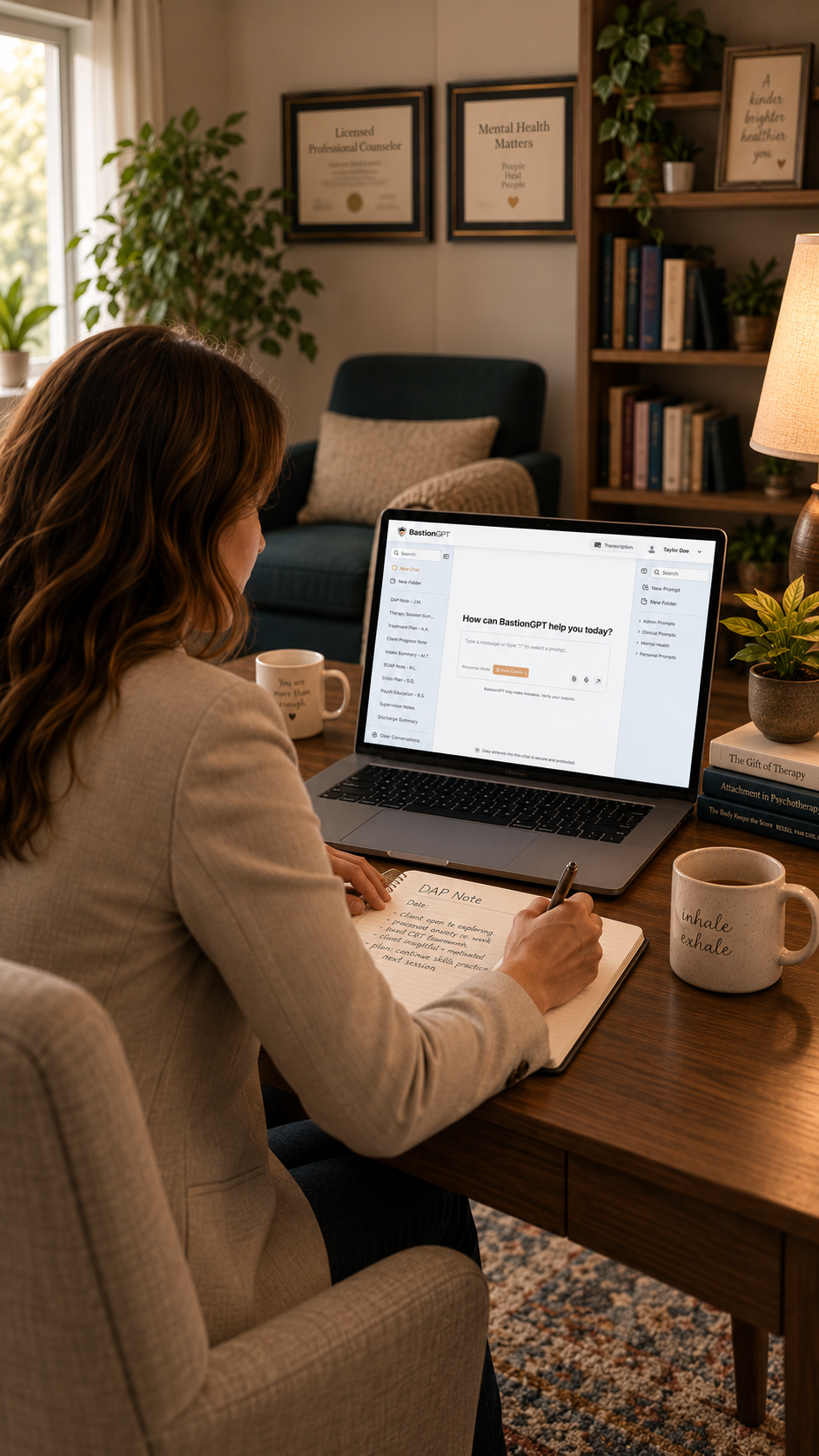
What an AI scribe can do for a DAP note. BastionGPT drafts a structured DAP note from a few bullets, a dictation, an uploaded recording, or a pasted transcript. It converts between DAP, SOAP, BIRP, and narrative structures without losing clinical content, and it checks a finished note for missing time support, an Assessment that only restates the Data, and treatment plan linkage before you sign.
What stays with you. You are the author of the note. Review the draft, correct it, add the clinical reasoning only you have, and sign it. An AI draft is source material; the substantive edit you make on top of it is what separates an individualized record from a cloned one in an audit.
Consent and state law: check these before you record.
BastionGPT is designed to assist healthcare professionals with documentation and clinical workflows. It does not replace professional judgment, clinical expertise, or human oversight. All AI-generated output should be reviewed by qualified professionals before use in clinical settings.
BastionGPT works alongside the systems behavioral health practices already use, including SimplePractice, TherapyNotes, TheraNest, Valant, CounSol, and ICANotes, through a copy or upload workflow with nothing for IT to install. HIPAA-compliant with a signed BAA on every plan, including the free trial.
"It's restored the human component to my practice."
Emma Levy, Clinical Psychologist
Sources (13)
Claims on this page trace to these authorities, last verified August 2026:
Educational content, not legal or billing advice. Sample notes are fictional. Follow your organization's policies and your board, payer, and jurisdiction requirements.
If you still have questions, reach out to us via live chat in the bottom right of your screen, or schedule a meeting to speak with a healthcare AI expert.